
Architecture Overview
SecureSign Escrow is execution infrastructure — not a custodial platform,
not a decision layer, and not a counterparty.
This page explains how the system is structured, where trust boundaries
are enforced, and why execution remains deterministic and verifiable
beyond the interface.
Execution rules are defined upfront. Not interpreted afterwards.

What SecureSign Escrow is — and is not
SecureSign Escrow is designed as execution infrastructure for agreements. It provides deterministic execution based on predefined rules, without assuming roles that introduce discretion or liability.
This separation of roles is intentional and foundational to the trust and compliance properties of the system.

System components
SecureSign Escrow is composed of modular components that work together as one execution flow. Each component has a defined responsibility and a clear trust boundary.
The system is designed so that the signed agreement and execution logic remain aligned throughout the deal lifecycle.

Trust boundaries
SecureSign Escrow is explicitly designed around clear trust boundaries. These boundaries define where the platform's responsibility ends and where the parties retain full control.
By enforcing strict trust boundaries, the system minimizes reliance on platform trust and maximizes execution certainty.

Execution lifecycle
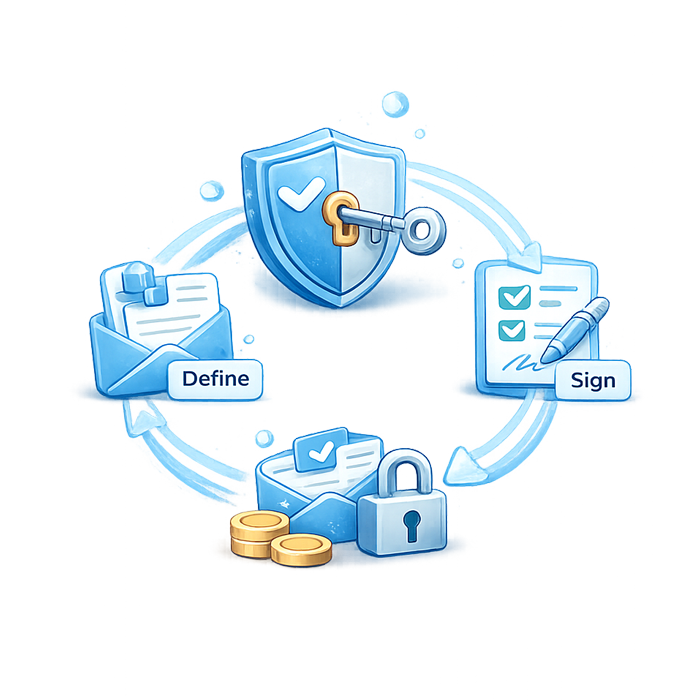
Every SecureSign Escrow deal follows the same execution lifecycle. This lifecycle is fixed before signing and governs how funds move from agreement to outcome.
Once the agreement is signed, the lifecycle progresses deterministically. No step can be skipped, reordered, or altered by the platform.
Failure scenarios and resilience
SecureSign Escrow is designed to handle failure scenarios without breaking execution guarantees or introducing discretionary behavior.
These scenarios are accounted for at design time, ensuring that execution does not depend on ad-hoc intervention.

What remains verifiable
At every stage of the deal lifecycle, key elements remain independently verifiable — without requiring trust in the platform's continued operation.
Verifiability ensures that parties, auditors, or third parties can independently confirm what was agreed and what executed.

What this means for legal and compliance teams
The SecureSign Escrow architecture is designed to reduce legal ambiguity and operational risk by eliminating discretionary execution and unclear enforcement paths.
This allows legal and compliance teams to reason about risk, responsibility and enforceability based on defined rules rather than platform behavior.